What Does 30% Glycolic Acid Really Mean?
When you’re shopping for a chemical peel, it’s natural to look first at the percentage printed on the bottle.
10%.
20%.
30%.
40%.
It’s tempting to assume those numbers tell you everything you need to know about an acid product.
They don’t.
At Makeup Artist’s Choice, we believe consumers using professional-quality acids deserve to understand what those percentages actually represent.
That’s why we want to explain something that has been fundamental to the way we’ve formulated our acid products throughout our history:
Free Acid Value — or FAV.
Makeup Artist’s Choice has always formulated our acid products using Free Acid Value.
When an MUAC product states an acid percentage, that percentage represents the available acid value in the formulation.
In simple terms:
If an MUAC product says 30% Glycolic Acid, that means 30% Glycolic Acid Free Acid Value.
That’s the standard we’ve used since our earliest days of formulating professional-quality acids.
And it’s an important distinction.
What Is Free Acid Value?
Acids used in skincare can exist in different chemical forms within a finished formulation.
Depending upon how a product is formulated and adjusted, not all of the acid associated with a formula is necessarily present in the same available acid form.
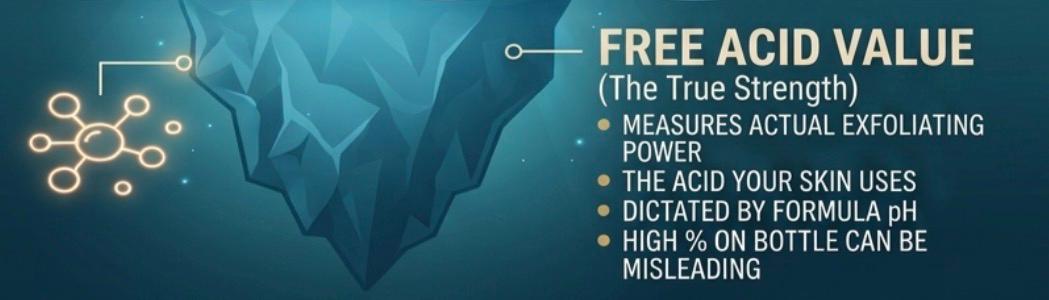
Free Acid Value describes the amount of acid available in its free-acid form within the formulation.
This is different from simply looking at the total amount of acid-related material used to manufacture a product.
That distinction can be confusing for consumers because the front of a bottle usually gives you only one very noticeable piece of information:
the percentage.
But without understanding what that percentage represents, comparing one acid product with another based solely on the number printed on the label can be misleading.
What Does FAV Mean at Makeup Artist’s Choice?
At MUAC, we’ve kept our approach straightforward.
Our stated acid percentages are Free Acid Values.
If we tell you a product provides 30% glycolic acid, we mean a 30% Free Acid Value.
When we state another acid concentration, our percentage represents the Free Acid Value of that acid as formulated.
We don’t believe consumers should have to guess what our percentages mean.
Our acid formulations are professionally developed by our chemists according to the Free Acid Values we specify, with careful attention also given to the pH of the finished formulation.
We’ve followed this philosophy throughout our history because meaningful chemical peel information involves more than putting an impressive percentage on a bottle.
Percentage Matters — But It Isn’t the Whole Story
Imagine two products sitting side by side.
Both bottles say:
30% Glycolic Acid.
It’s very easy to conclude:
They’re both 30%, so they’re essentially the same.
That conclusion shouldn’t automatically be made.
The concentration of an acid matters, but the way an acid formulation behaves also depends on other characteristics of the finished product.
One particularly important characteristic is:
pH.
What Is pH?
You don’t need a chemistry degree to understand the basic concept.
The pH scale describes how acidic or alkaline a formulation is.
A pH of 7 is neutral.
Numbers below 7 are acidic.
Numbers above 7 are alkaline.
Chemical exfoliating acids are formulated on the acidic side of the scale.
But here’s the important part for skincare consumers:
Acid percentage and the pH of the finished product are not the same measurement.
A bottle that says 30% glycolic acid tells you about the amount of glycolic acid represented by that percentage.
The pH tells you something different about the acidity of the finished formulation.
Both pieces of information can matter when understanding an acid product.
Why Does pH Matter?
With alpha hydroxy acids such as glycolic and lactic acid, pH is an important part of the finished formulation and can influence how the product behaves on the skin.
This is why simply comparing percentages isn’t enough.
A consumer shouldn’t assume that every product labeled with the same acid percentage will behave identically.
Concentration matters. pH matters. The finished formulation matters.
At MUAC, our chemists formulate our acid products according to the Free Acid Value and finished-product pH specifications established for each particular formulation.
A Higher Percentage Isn’t Automatically a Better Peel
This may be one of the most important lessons we’ve learned during nearly three decades of specializing in at-home chemical peels:
Stronger isn’t automatically better.
A consumer may see a higher acid percentage and assume it must produce better results than a lower percentage.
That’s not how we encourage our clients to choose chemical peels.
Your skin type matters.
Your previous experience with acids matters.
The type of acid matters.
The Free Acid Value matters.
The pH and overall formulation matter.
Application time matters.
And, most importantly, your individual skin response matters.
This is why MUAC offers different acids and different strengths rather than simply trying to manufacture the highest percentages possible.
The goal isn’t to win a numbers contest.
The goal is effective exfoliation appropriate for your skin.
Different Acids Can’t Be Compared by Percentage Alone
There’s another reason percentages can be misleading.
Different acids are different molecules with different characteristics.
A 25% mandelic acid peel should not be viewed simply as a weaker or stronger version of a 25% glycolic acid peel.
Mandelic acid has a larger molecular structure than glycolic acid and generally penetrates more slowly. This is one reason MUAC’s 25% Mandelic Acid Peel is among our preferred introductory peels.
Glycolic acid has a smaller molecular structure and behaves differently.
Lactic acid has its own characteristics.
Salicylic acid is a beta hydroxy acid with an affinity for oil and is frequently selected when congestion, blackheads and oily skin are primary concerns.
TCA belongs to a different category of chemical peeling altogether.
So when choosing a chemical peel, don’t ask only:
“What’s the percentage?”
Also ask:
“What acid is it?”
“What does that percentage represent?”
“What is the product designed to do?”
“Is this appropriate for my skin and my experience level?”
Those questions tell you much more than simply chasing the biggest number on a bottle.
Why MUAC Uses Free Acid Value
Makeup Artist’s Choice began specializing in professional-quality at-home chemical peels in 1997.
We were working with acids long before at-home chemical peeling became the enormous skincare category consumers recognize today.
From the beginning, we believed consumers deserved to understand what they were purchasing and how to use these products responsibly.
That’s why we have always formulated our acid products using Free Acid Value.
It isn’t a new marketing term we’ve added to our products.
It’s how we’ve approached acid formulation throughout our history.
When we state an acid percentage, we want our clients to understand what we’re telling them.
30% Glycolic Acid means 30% Glycolic Acid Free Acid Value.
Clear information matters when you’re working with professional-quality acids.
Free Acid Value and pH: Related, But Not the Same Thing
This is worth repeating because the two terms can easily become confused.
Free Acid Value tells you about the available acid value in the formulation.
pH tells you about the acidity of the finished formulation.
They are related aspects of acid formulation, but they are not interchangeable measurements.
At MUAC, our chemists consider both when developing our acid products.
And this is another reason we discourage consumers from comparing chemical peels based on the percentage printed on the bottle alone.
What Should You Consider When Choosing a Chemical Peel?
Rather than simply searching for the highest percentage available, consider the entire product and whether it is appropriate for your skin.
Consider:
- The type of acid
- The Free Acid Value
- The pH and overall formulation
- Your skin type and concerns
- Your previous experience with chemical exfoliation
- The manufacturer’s directions and recommended application time
- Appropriate patch testing
- Proper post-peel care
- Consistent sun protection
And if you’re new to chemical peeling, begin conservatively.
You can always progress after learning how your skin responds.
Sun Protection Matters
Chemical exfoliation and sun protection belong in the same conversation.
Alpha hydroxy acids can increase sensitivity to ultraviolet exposure, which makes appropriate sun protection particularly important when using these products.
MUAC recommends broad-spectrum SPF 30 or higher following chemical exfoliation and as part of your daily skincare routine.
Always follow the specific directions provided with your individual peel.
Nearly Three Decades of Working With Acids Has Taught Us Something Important
Skincare marketing loves numbers.
Higher percentages look powerful.
They fit beautifully on bottles.
They make dramatic advertisements.
But your skin doesn’t respond to marketing.
Your skin responds to the formulation.
That’s why Makeup Artist’s Choice has always believed in telling clients what our acid percentages represent.
Free Acid Value matters.
pH matters.
The type of acid matters.
Proper application matters.
Your individual skin matters.
And ultimately, the principle that guides our approach to Free Acid Value is the same principle that has guided our chemical peel philosophy since 1997:
You Don’t Need the Strongest Peel. You Need the Right Peel.
MAKEUP ARTIST’S CHOICE
Professional-quality at-home chemical peels and advanced skincare since 1997.
When we state an acid percentage, we believe you should know what that percentage means.