
Why Choose Makeup Artist’s Choice Chemical Peels?
Nearly three decades of at-home chemical peel expertise—since 1997.
Chemical peels can be remarkably effective tools for improving the appearance of dullness, uneven texture, clogged pores, blemishes, discoloration, fine lines, sun damage and other visible signs of aging.
But there is no single chemical peel that is right for everyone.
The right peel depends on your skin type, your primary concerns, your previous experience with acids and, most importantly, how your individual skin responds to chemical exfoliation.
At Makeup Artist’s Choice, chemical peels aren’t a recent addition to our skincare collection.
They have been at the heart of what we do since 1997.
We were there during the early days of at-home chemical peeling, helping consumers understand acids and providing a broad range of professional-quality peel options at a time when choices available to the public were extremely limited.
We didn’t simply watch the at-home chemical peel industry develop. We helped build it.
Nearly three decades later, our philosophy remains remarkably simple:
The best chemical peel isn’t necessarily the strongest peel. It’s the peel that’s right for your skin.
That is why MUAC offers different acids and multiple strengths, along with detailed instructions designed to help clients begin conservatively and progress appropriately.
So, which chemical peel is right for you?
Let’s look at the differences.
Glycolic Acid Peels
The Classic Multi-Tasking AHA
Glycolic acid is one of the best-known alpha hydroxy acids—and for good reason.
Its relatively small molecular size makes it an effective exfoliating acid for removing accumulated surface cells and revealing smoother, brighter and more refined-looking skin.
Glycolic acid may be an excellent choice for concerns including:
- Dull, rough or uneven-looking texture
- Fine lines and visible signs of aging
- Congested-looking pores and blackheads
- Blemish-prone skin
- Uneven-looking pigmentation
- The visible effects of sun damage
MUAC offers glycolic acid in several strengths, allowing clients to select a peel appropriate for their previous experience and skin tolerance.
For experienced users, our 70% Adjustable Glycolic Acid Peel provides additional flexibility. Using MUAC’s dilution recipes, different concentrations can be prepared from 20% through 70%.
This allows clients to begin conservatively and adjust gradually rather than assuming the highest concentration is automatically the best choice.
Best thought of as: versatile resurfacing for texture, brightness, pores, discoloration and visible signs of aging.
Lactic Acid Peels
Effective Exfoliation With a Gentler Touch
Lactic acid is another alpha hydroxy acid, but for many clients it can provide a gentler exfoliating experience than glycolic acid.
It may be particularly appealing for dry, mature or more sensitive skin types seeking the benefits of an AHA while taking a more conservative approach.
MUAC Lactic Acid Peels help remove accumulated surface cells and improve the appearance of dullness, uneven texture, fine lines and uneven-looking pigmentation.
Our lactic formulations also incorporate licorice extract, an ingredient commonly found in skincare designed to improve the appearance of uneven tone.
Clients can begin with an appropriate lower strength and progress only after determining how their individual skin responds.
Best thought of as: gentle but effective exfoliation for softer, smoother and brighter-looking skin.
Mandelic Acid Peels
An Excellent Starting Point for Beginners
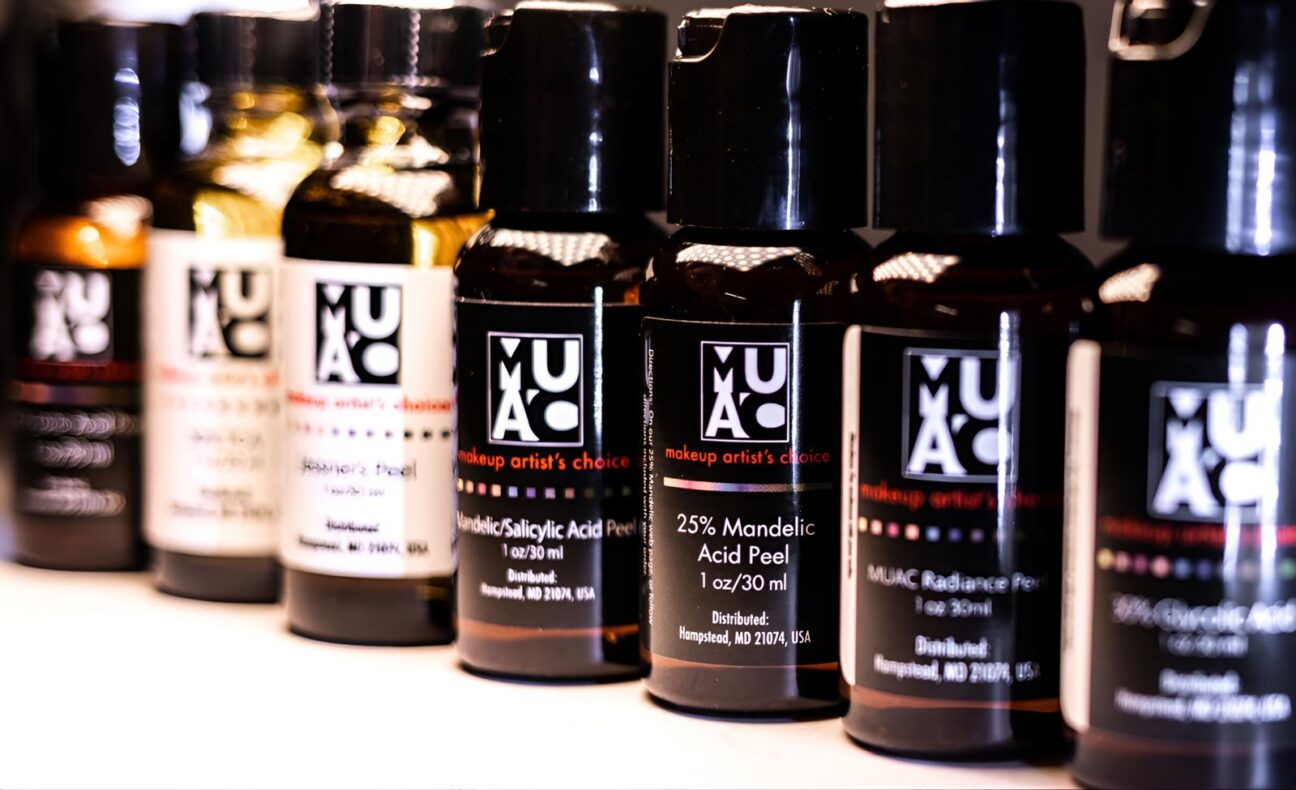
If you’ve never used a chemical peel before, MUAC’s 25% Mandelic Acid Peel is an excellent place to begin.
Mandelic acid is an alpha hydroxy acid derived from bitter almonds. Its molecular structure is larger than glycolic and lactic acid, causing it to penetrate the skin more slowly.
For many clients, this can mean effective exfoliation with less topical irritation.
Mandelic acid can help improve the appearance of:
- Clogged-looking pores and blackheads
- Blemish-prone skin
- Uneven texture
- Dullness
- Post-blemish discoloration
- Uneven-looking skin tone
Mandelic acid is also an acid we frequently consider for darker skin tones, where a more conservative approach to chemical exfoliation may be particularly desirable.
Clients who have successfully completed a series of treatments with our 25% Mandelic Acid Peel may consider progressing to our stronger 40% formulation.
Best thought of as: beginner-friendly exfoliation for clearer-looking pores, smoother texture and brighter, more even-looking skin.
Salicylic Acid Peels
When Oil, Blackheads and Congestion Are the Concern
Salicylic acid is a beta hydroxy acid, or BHA, particularly suited to oily, congested and blemish-prone skin.
Because salicylic acid is oil-soluble, it can be especially useful when the primary concerns include excess oil, clogged pores and blackheads.
MUAC offers a 15% Salicylic Acid Peel as well as our Mandelic/Salicylic Peel, which combines two different types of chemical exfoliation in one formulation.
The mandelic/salicylic combination can be an excellent option for appropriate clients dealing with a combination of congestion, blemishes, uneven texture and the visible discoloration blemishes can leave behind.
Important: Salicylic acid products should not be used by individuals with an aspirin/salicylate allergy.
Best thought of as: targeted exfoliation for oily, congested, blackhead-prone and blemish-prone skin.
Jessner’s Peel
Multi-Acid Exfoliation for More Experienced Peel Users
For clients ready to move beyond introductory acids, MUAC’s Jessner’s Peel provides a more intensive combination approach to chemical exfoliation.
Our traditional Jessner’s formulation combines:
14% Lactic Acid + 14% Salicylic Acid + 14% Resorcinol in an alcohol base.
Each component contributes different properties to the formulation, allowing Jessner’s to address several visible skin concerns simultaneously.
It may be considered for the appearance of:
- Oily and congested skin
- Blackheads
- Blemish-prone skin
- Uneven texture
- Uneven-looking pigmentation
- Sun-damaged appearance
- Visible signs of aging
Jessner’s is not where we recommend beginning an at-home chemical peeling program.
It is better suited to clients who have developed experience with chemical exfoliation and understand how their skin responds. Visible peeling or flaking can occur following treatment.
As with other salicylic-acid products, Jessner’s should not be used by individuals with an aspirin/salicylate allergy.
Best thought of as: more intensive multi-acid resurfacing for experienced peel users addressing oil, congestion, texture, discoloration and visible sun damage.
TCA Peels
Advanced Chemical Peeling Requires Thoughtful Progression
TCA—trichloroacetic acid—belongs to a more advanced category of chemical peeling.
MUAC offers a progressive TCA program with 12.5%, 15%, 18% and a 30% Adjustable TCA Peel.
If you have never used TCA, we recommend beginning with our 12.5% formulation rather than starting aggressively.
Once your skin has demonstrated that it tolerates TCA successfully, you may consider progressing gradually through appropriate strengths.
Our 30% Adjustable TCA Peel is intended for experienced TCA users and includes recipes allowing the solution to be diluted to different concentrations. 30% TCA should never be used at full strength.
TCA may be considered when concerns include more significant-looking photo-aging, uneven pigmentation, deeper-looking lines, rough texture and certain types of visible scarring.
This is one area where we cannot emphasize our philosophy strongly enough:
Stronger isn’t automatically better. Proper progression is better.
Patch testing, preparation, precise application and appropriate post-peel care become especially important when using advanced chemical peels.
Best thought of as: advanced resurfacing for experienced peel users addressing more significant visible signs of aging, discoloration, texture and certain visible scars.
Fade Peel
A Multi-Acid Approach to Uneven-Looking Pigmentation
Discoloration is often complex, which is why MUAC’s Fade Peel doesn’t rely on a single exfoliating ingredient.
Our Fade Peel combines glycolic, lactic, kojic and malic acids in a multi-acid formulation designed particularly for clients concerned with the appearance of uneven pigmentation.
It may be considered for concerns including:
- Dark spots
- Post-blemish marks
- Uneven-looking skin tone
- Visible sun damage
- Age-related discoloration
- Dullness
For clients developing a more comprehensive routine for uneven-looking pigmentation, MUAC Fade Serum can provide additional targeted skincare between appropriately scheduled peel treatments.
Best thought of as: targeted multi-acid exfoliation when dark spots and uneven-looking pigmentation are primary concerns.
Phytic Acid and the PhytX Overnight Peel
A Different Approach to Brightening and Exfoliation
Our PhytX Overnight Peel takes a different approach from our traditional timed, rinse-off peels.
Rice-derived phytic acid is combined with mandelic, glycolic and lactic acids plus hyaluronic acid to create a superficial overnight treatment.
PhytX is designed to provide chemical exfoliation while improving the appearance of dullness, uneven tone, texture and radiance.
Unlike most MUAC chemical peels, PhytX is designed to remain on the skin overnight according to its specific directions rather than being treated as a traditional rinse-off peel.
Phytic acid also has a place elsewhere in the MUAC skincare collection, including our 20% Vitamin C Serum with Phytic Acid, where it complements an antioxidant-focused skincare routine.
Best thought of as: superficial overnight exfoliation for smoother, brighter and more radiant-looking skin.
Which Chemical Peel Is Right for Me?
This is one of the questions we’ve been asked most frequently during nearly three decades of working with at-home chemical peels.
There is no universal answer, but these general guidelines can help point you in the right direction.
New to chemical peels?
Consider beginning with 25% Mandelic Acid or another appropriate introductory AHA rather than immediately reaching for a stronger peel.
Dry, mature or more sensitive skin?
Consider Lactic Acid or a conservative Mandelic Acid program.
Dullness, rough texture or visible signs of aging?
Glycolic Acid provides versatile chemical exfoliation and may be an excellent option.
Oily skin, blackheads or congested-looking pores?
Consider Salicylic Acid or an appropriate Mandelic/Salicylic formulation.
Dark spots and uneven-looking pigmentation?
Depending upon your skin type and experience, options may include the Fade Peel, Mandelic Acid, Lactic Acid or another pigmentation-focused routine.
Ready for more intensive multi-acid exfoliation?
Experienced peel users may consider Jessner’s Peel.
Experienced with chemical peels and looking for more advanced resurfacing?
An appropriately selected TCA Peel may be considered, beginning with the lowest appropriate strength.
And when you’re unsure:
Choose conservatively.
You can always progress to a stronger treatment after learning how your skin responds.
Chemical Peels Are Only Part of Good Skincare
One of the most important lessons we’ve learned during nearly three decades of working with acids is that exfoliation is only one part of caring for your skin.
What you use before, between and after your chemical peels matters.
Cleanse Gently
Begin with clean skin without unnecessarily stripping it.
Our Green Tea/Pomegranate Cleansing Gel provides gentle cleansing and can be incorporated into both a peel routine and everyday skincare.
Understand Moisture vs. Hydration
Moisturizing and hydration are related, but they are not the same thing.
A moisturizer primarily works topically, helping soften the skin, support the surface barrier and reduce moisture loss.
Hydration focuses on increasing and maintaining the skin’s water content.
This is why we place such importance on hyaluronic acid in an appropriate post-peel routine.
MUAC’s Advanced Hyaluronic Acid Serum uses two forms of hyaluronic acid with different molecular characteristics to provide multi-level hydration. Hyaluronic acid acts as a humectant, helping attract and retain water without adding another exfoliating acid.
A moisturizer can still play an important role when the skin needs additional surface comfort and barrier support.
But a moisturizer and a hydrating serum are not interchangeable products.
Hydrate the skin. Support its barrier. Protect it from the sun.
Support Your Skin Between Peels
MUAC offers complementary treatments that can be incorporated at appropriate times between peel treatments, depending upon your individual routine.
These include Vitamin C, retinol, pigmentation-focused formulas and acid/hyaluronic serums.
One of our longtime favorites is GLY-LURONIC Serum, which combines glycolic exfoliation with hyaluronic hydration.
The important principle is not to introduce every active ingredient at once.
Good skincare is thoughtful skincare.
Protect Your Skin From the Sun
Chemical exfoliation makes diligent sun protection especially important.
Use broad-spectrum SPF 30 or higher following chemical peeling and as part of your daily skincare routine.
Safety Comes Before Strength
Every MUAC peel includes specific directions because different acids and different strengths require different protocols.
Before using any chemical peel:
- Read the complete directions for that particular product.
- Always perform the recommended patch test before full application.
- Do not apply chemical peels to inflamed, irritated, sunburned or broken skin.
- Follow the recommended preparation and application instructions.
- Do not assume that more product, additional layers or longer application will produce better results.
- Follow the appropriate post-peel instructions.
- Use broad-spectrum SPF 30 or higher following exfoliation.
- Never manually pull, pick or prematurely remove peeling skin.
- Pay careful attention to contraindications for the particular acid you are using.
If you use prescription skincare, are undergoing medical treatment, have a skin condition or are uncertain whether a chemical peel is appropriate for you, consult an appropriately qualified healthcare professional before use.
And remember:
Your skin doesn’t care what percentage is printed on the bottle. It cares how the formulation interacts with your skin.
Why Makeup Artist’s Choice?
Because chemical peels aren’t a trend to us.
They’ve been our specialty since 1997.
We offer different acids because different skin concerns require different approaches.
We offer different strengths because a first-time peel user and an experienced peel user shouldn’t necessarily be using the same treatment.
We encourage clients to start conservatively and progress gradually.
We emphasize patch testing because individual skin response matters.
We provide detailed instructions because professional-quality acids deserve respect.
We offer complementary skincare because what happens before, between and after your peels matters, too.
And after nearly three decades, we remain guided by one fundamental principle:
You Don’t Need the Strongest Peel. You Need the Right Peel.
Whether you’re concerned with fine lines, blemishes, blackheads, congestion, rough texture, sun damage, uneven-looking pigmentation, visible scarring or simply dull-looking skin, the answer isn’t automatically a stronger acid.
It’s understanding your skin and choosing intelligently.
That’s what Makeup Artist’s Choice has been helping clients do since 1997.
MAKEUP ARTIST’S CHOICE
Professional-quality at-home chemical peels and advanced skincare since 1997.
We didn’t simply watch the at-home chemical peel industry develop. We helped build it



I appreciate the emphasis on best practices. https://traderzo.com/